

The other day while walking near Lucky’s Market in North Boulder, I witnessed a daring rescue. Two good Samaritans scooped up a baby bird from the middle of Broadway and transported it to nearby bushes on the west side of the road.
Given the scenario, the action was absolutely necessary. But I couldn’t help wondering – is this baby now doomed to be abandoned?
You’re likely familiar with the “rule” that many of us were taught as children: never touch baby birds, or the mother bird will reject her own offspring. It’s generally believed that the mere scent of a human on a nestling or fledgling will spook the mother bird into abandoning the child.
Turns out, this isn’t true. In fact, birds have a limited sense of smell and cannot detect human scent at all. So where did this suburban myth come from?
While warnings to leave baby birds and other wildling progeny alone might be exaggerated to leave an impression, they’re founded in a solid desire to protect them from well-meaning folks who might scoop up a baby and take them away. In most cases, the mother is not far away, and moving the baby is going to cause way more damage than allowing the mother time to come back.
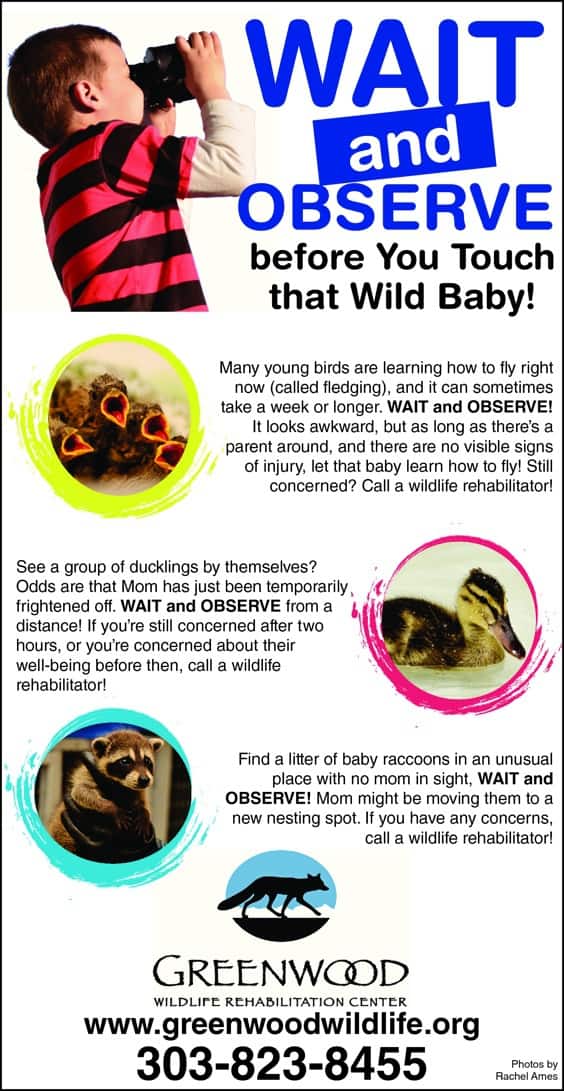
So what’s the best approach? According to Boulder’s Greenwood Wildlife Rehabilitation Center, here’s the perfect advice:
Wait and Observe!
Before you touch that baby, simply wait and observe. Here are some handy guidelines in graphical form provided by Greenwood.